
Published on martech.blog • Category: AI & Automation • Reading Time: ~18 min
Tags: AI Marketing, Marketing Automation, MarTech Stack, Demand Generation, Personalization, ROI
| U.S. Digital Ad Market | Marketing Job Growth | Talent Gap | AI Adoption Rate |
| $360.4B in 2025 | 8% through 2033 | 230,000 specialists | ~72% of U.S. ad spend is digital |
I’ve Spent Weeks Testing These Tools. Here’s What You Actually Need to Know.
If you’re still on the fence about AI marketing automation in 2026, I’m going to be blunt with you: that fence burned down about 18 months ago. The question isn’t whether to use these tools anymore — it’s which ones won’t waste six months of your team’s life and a third of your tech budget.
The U.S. digital advertising market hit $360.4 billion in 2025 and it’s tearing toward $975 billion by 2032 at a 15.3% CAGR. Every dollar in that pile is fighting for the same eyeballs. You cannot win that fight manually. I don’t care how talented your team is.
And here’s what nobody tells you plainly enough — AI isn’t coming for your job. I know that’s what the breathless LinkedIn takes say, but the reality is messier and more interesting. The shift happening right now is from execution to orchestration. The marketers I know who are genuinely thriving aren’t the ones hiding from AI tools; they’re the ones who figured out how to direct them like a conductor instead of playing every instrument themselves.
“The real skill now is briefing, prompting, and editing AI outputs — not fearing them. Creativity, empathy, and brand storytelling still belong entirely to humans. The tools just remove the grunt work that was eating your best people’s most productive hours.”
What follows is my actual working breakdown of the AI marketing automation landscape in 2026 — tools I’ve evaluated, data I’ve dug into, implementation traps I’ve watched teams fall into, and ROI frameworks that hold up under scrutiny. I’ve written this for marketing directors sizing up platforms, specialists trying to level up fast, and MarTech architects who need a reality check on what’s actually shipping vs. what’s still vapor. All of those people are welcome here.
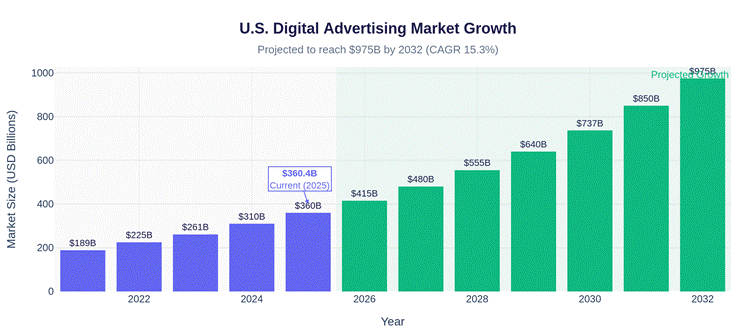
Figure 1: U.S. Digital Advertising Market Growth — projected to reach $975B by 2032 (CAGR 15.3%)
Why This Stuff Actually Matters Right Now (Not in a Vague Way)
Look, I could give you the industry boilerplate about ‘unprecedented digital transformation,’ but that’s not useful. Let me give you the actual numbers that make this urgent.
- 230,000 unfilled digital marketing positions in major U.S. metro areas. That’s not a rounding error — it’s a structural talent shortage that automation directly patches.
- LinkedIn is sitting on 860,000+ open ‘Digital Marketing Specialist’ postings right now. Top 10 most in-demand job in the country. There are not enough humans to fill these roles.
- The average consumer spends nearly 7 hours a day online. Seven. Hours. No manual marketing process touches that many moments.
- Personalization expectations have shifted permanently. Generic campaigns get ignored. That’s not a trend — it’s now just how humans behave online.
- The data volumes marketing teams are expected to analyze would’ve required a dedicated data science squad three years ago. Now it’s table stakes for a mid-size team.
Those five problems? AI automation takes a run at all of them — and makes meaningful dents. Here’s the breakdown.
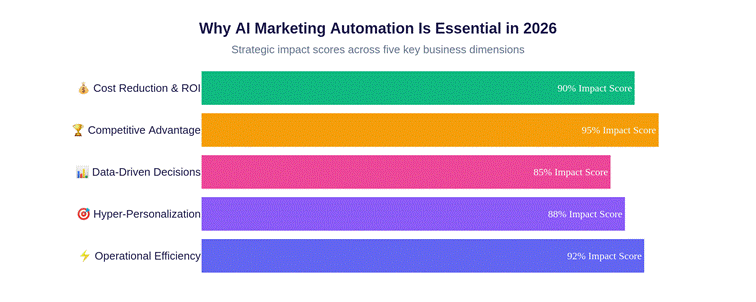
Figure 2: Five strategic dimensions where AI marketing automation delivers measurable business impact
1. Operational Efficiency — The One That Shows Up in the First 90 Days
AI handles the work nobody actually wants to do: segmenting lists, scheduling sends, adjusting bids, executing A/B tests, generating first-draft email copy. What used to eat a small team’s entire week now runs in the background. I’ve watched a single sharp marketer orchestrate campaigns that would’ve needed four people eighteen months ago. That’s not hype — I’ve seen the Asana boards.
2. Personalization That’s Actually Personal (Not Just ‘Hey [First Name]’)
Real personalization isn’t slapping someone’s name in a subject line — that’s been table stakes since 2015. What AI enables is genuine 1:1 content adaptation: the right channel, message, timing, and offer for each individual, driven by behavioral signals rather than demographic guesses. The conversion rate differential between this and old-school segmentation is not small. We’re talking 20-40% improvements in the studies I find credible.
3. Analytics Without a PhD Required
Predictive modeling, CLV forecasting, attribution analysis, churn prediction — these used to live exclusively in data science teams. Now they’re embedded features in platforms that a marketing generalist can actually operate. That’s a genuinely big deal. I’ve seen mid-market teams make budget allocation decisions in an afternoon that would’ve taken a quarter to surface analytically three years ago.
4. The Competitive Reality Nobody Wants to Admit
Your competitors are already using this. Not all of them, not perfectly, but enough of them that the gap compounds month over month. I’m not saying this to create urgency for its own sake — I’m saying it because I’ve watched the pipeline data on both sides of this divide and it’s not subtle. For a growing number of businesses, AI automation adoption isn’t about getting ahead anymore. It’s about not falling permanently behind.
5. The ROI Math Is Hard to Argue With
Lower cost-per-lead. Less ad spend waste. Better email deliverability. Higher conversion rates. Improved retention. When you stack those up against platform costs — even at the enterprise tier — the math usually works. I’ve yet to see a well-implemented AI marketing automation program fail to pay for itself within 12 months. Badly implemented ones absolutely can. The difference is usually data quality and team training, not the technology.
The Six Platforms Worth Your Serious Attention in 2026
The market has consolidated enough that there are really six platforms doing this well — with very different strengths, price points, and ideal use cases. I’ve organized them by who they’re actually built for, not by marketing category, because the right answer is almost entirely determined by your company size, business model, and existing stack.
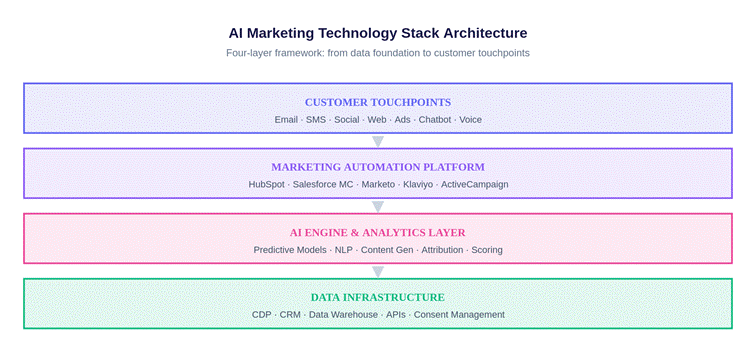
Figure 3: AI Marketing Technology Stack — Four-layer architecture from data infrastructure to customer touchpoints
1. HubSpot Marketing Hub — My Pick for Most Teams
Best for: SMB to mid-market companies who want an all-in-one system that doesn’t require a full-time administrator to keep running.
HubSpot wins here, period — for any team that isn’t squarely enterprise. They’ve done something most of their competitors haven’t managed: built an AI layer that feels native to the platform rather than bolted on. The AI content assistant generates email copy, landing page headlines, and CTAs that I’d actually use as starting points (not throw away and rewrite). The predictive lead scoring actually improves over time as it learns from your CRM data. And the Smart Send optimization — which determines optimal delivery time per individual recipient — genuinely moves open rate numbers. I’ve seen it pull 12-18% improvements in testing scenarios.
- AI Content Assistant: Generates and optimizes email copy, CTAs, and landing page content — usable first drafts, not garbage to delete
- Predictive Lead Scoring: ML-powered identification of high-intent prospects; gets smarter the longer you use it
- Smart Scheduling: AI-determined optimal send times based on individual recipient behavior history
- Multi-Channel Workflows: Automated sequences across email, social, ads, and CRM — all in one place
- Conversational AI: Built-in chatbots for website visitor engagement that actually qualify leads
- Attribution Reporting: Multi-touch attribution across the full funnel — finally, answers that hold up in budget meetings
Pricing: Starter from ~$20/month; Professional from ~$890/month; Enterprise from ~$3,600/month. The Professional tier is where the real AI features live — budget accordingly.
2. Salesforce Marketing Cloud (Einstein AI) — Exceptional Power, Brutal Implementation
Best for: Enterprise organizations with complex, multi-touchpoint customer journeys and the IT resources to implement properly.
Salesforce Marketing Cloud with Einstein AI is the most capable enterprise marketing platform available — and also the most punishing to implement badly. Einstein AI is woven through the entire platform: it scores engagement probability on every contact, generates personalized content recommendations, predicts churn before your account managers see the signals, and optimizes send strategies across what can be billions of customer interactions. The Journey Builder combined with Einstein is genuinely unmatched for complex customer journey orchestration. If you’re enterprise and your customer journey spans 15+ touchpoints across 6+ months — this is your platform. If you’re not enterprise, it will eat your team alive and crater your confidence in AI tools generally.
- Einstein Engagement Scoring: Predicts which contacts are most likely to engage — runs continuously across your entire database
- Einstein Send Time Optimization: Per-contact optimal send windows; not batch-and-blast, actual individual-level timing
- Einstein Copy Insights: AI analysis of subject line and body copy performance — shows you what’s working and why
- Journey Builder: Visual multi-channel journey orchestration — complex but extremely powerful once configured
- Predictive Audiences: ML-powered audience segmentation for ad targeting with real lookalike capability
- Einstein Language: NLP for sentiment analysis and message optimization across channels
Pricing: Enterprise-grade. Starts around ~$1,500/month for basic editions and scales quickly with features and contact volume. Get a custom quote and negotiate hard.
3. Marketo Engage (Adobe Experience Cloud) — The B2B ABM Heavyweight
Best for: B2B enterprises running sophisticated account-based marketing programs, particularly those already embedded in the Adobe ecosystem.
Marketo is the tool serious B2B demand gen teams reach for when complexity of lead management is the core problem. Adobe Sensei — Adobe’s AI framework — powers the predictive content recommendations, intelligent audience segmentation, and lead scoring refinement. The platform’s strength is its depth of integration with the Adobe Experience Cloud: connect automation to Adobe Analytics, Adobe Target for personalization, and Adobe CDP for customer data management. If you’re running ABM at scale with multiple buying committee members per account, coordinated multi-channel touchpoints, and revenue cycle analytics that need to tie directly to closed deals — Marketo is hard to beat. If you’re not running ABM, the complexity premium isn’t worth it.
- Predictive Audiences: AI-powered segmentation and lookalike audience creation using Adobe Sensei
- AI Content Recommendations: Sensei surfaces the right content for each lead based on behavioral patterns
- Advanced Lead Management: Sophisticated scoring models with both behavioral and demographic signals
- Account-Based Marketing: Coordinate and measure campaigns at the account level — not just the lead level
- Revenue Cycle Analytics: Full-funnel attribution from first touch to closed revenue; the CFO-ready reporting
- Web Personalization: Dynamic content adaptation based on visitor attributes and behavioral history
Pricing: From ~$895/month (Spark) to enterprise custom pricing for larger databases. The gap between entry-level and what you actually need can be significant — map your requirements carefully.
4. Klaviyo — The E-Commerce Standard, and for Good Reason
Best for: E-commerce brands on Shopify, WooCommerce, or similar platforms who want email and SMS automation that’s actually connected to purchase data.
Klaviyo has basically won the e-commerce email and SMS automation category — and their 2026 AI capabilities are a big part of why. The platform’s predictive analytics engine is genuinely impressive: it forecasts customer lifetime value, next predicted order date, churn probability, and expected spending per customer. Which means your segmentation isn’t based on demographic guesses — it’s based on behavioral and predictive data that’s specific to your store. The product recommendation AI, send time personalization, and smart segmentation all update automatically as customer behavior changes. I’ve seen well-run Klaviyo programs deliver 30-45% of an e-commerce brand’s total revenue through email and SMS alone.
- Predictive CLV Scoring: Forecasts each customer’s lifetime value and buying patterns — segment by future worth, not just past spend
- AI Product Recommendations: Personalized suggestions based on browsing and purchase history — drives repurchase rates meaningfully
- Send Time Optimization: Per-recipient optimal send window determination; actual individual-level intelligence
- Smart Segmentation: Behavior-based dynamic segments that update automatically — no manual maintenance
- SMS + Email Automation: Unified cross-channel automation in one platform — stops the fragmented tool mess
- Revenue Attribution: Direct connection between email/SMS campaigns and store revenue; shows your boss exactly what the spend generates
Pricing: Free up to 250 contacts; scales by list size, typically $20–$1,700/month for growing brands. Competitive at scale for what you get.
5. ActiveCampaign — The Underrated Workhorse
Best for: SMBs and growth-stage businesses that need serious automation power without an enterprise implementation timeline and budget.
Here’s the tool I consistently see underestimated. ActiveCampaign sits at the intersection of simplicity and genuine power — and it holds that position better than anything else in the sub-$200/month range. The predictive sending capability, the dynamic content personalization, the ML lead scoring, and the pipeline win probability forecasting all perform meaningfully well. More importantly: you can be fully operational in weeks, not quarters. For a team that needs to show results before the next budget review, that speed matters enormously. The 850+ integrations also mean it plays nicely with whatever stack you’ve already built.
- Predictive Sending: AI-determined optimal send time per individual contact — not just ‘Tuesday at 10am for everyone’
- Predictive Content: Dynamic content blocks that adapt per subscriber based on behavior and preferences
- Machine Learning Lead Scoring: Automatic, continuously-improving scoring based on engagement and behavioral signals
- Win Probability: AI forecasting for sales pipeline opportunities — gives your sales team actual conversation starters
- Automation Map: Visual representation of your entire automation ecosystem — catches gaps before they become problems
- 850+ App Integrations: Connects to your existing stack without the 3-month integration project
Pricing: Starter from ~$15/month; Plus from ~$49/month; Professional from ~$79/month. Easily the best value-to-capability ratio in the market.
6. Mailchimp (with Intuit AI) — The Right First Step
Best for: Startups, solopreneurs, and small businesses who are starting from zero and need to grow into automation without a budget line item for onboarding consultants.
Yes, Mailchimp has had its ups and downs — and some of the competitor shade thrown its way over the years has been fair. But the Intuit acquisition accelerated its AI development meaningfully, and what they’re shipping in 2026 is genuinely useful for early-stage teams. The AI Creative Assistant generates on-brand email designs from your brand assets — surprisingly good outputs. The behavioral targeting, predictive demographics, and customer journey builder work well at the scale Mailchimp is designed for. The free tier has real functionality. For a bootstrapped startup figuring out marketing automation for the first time, this is the right on-ramp.
- AI Creative Assistant: Generates on-brand email designs from your uploaded brand assets — real time-saver for design-light teams
- Smart Audience Segmentation: Pre-built segments based on purchase behavior and engagement; no setup required
- Subject Line Helper: AI suggestions for improving open rates — not revolutionary, but consistently useful
- Predicted Demographics: ML-inferred audience characteristics for better targeting when your list is still building
- Customer Journey Builder: Visual automation flows for multi-step campaigns — simpler than enterprise tools, but functional
- Lookalike Audience Finder: Identifies new audiences similar to your best customers for paid expansion
Pricing: Free tier available (and genuinely useful); Essentials from ~$13/month; Standard from ~$20/month; Premium from ~$350/month.
At-a-Glance: How These Platforms Stack Up
| Platform | Best For | AI Highlight | Complexity | Free Tier | Starting Price |
| HubSpot | SMB to Mid-Market — All-in-One | AI Content + Predictive Lead Scoring | Medium | Yes | $20/mo |
| Salesforce MC | Enterprise — Complex Journeys | Einstein AI Full Suite | High | No | $1,500/mo |
| Marketo Engage | B2B Enterprise — ABM Programs | Adobe Sensei + ABM Engine | High | No | $895/mo |
| Klaviyo | E-Commerce — Shopify/WooCommerce | Predictive CLV + SMS Automation | Low–Medium | Yes (250) | $20/mo |
| ActiveCampaign | SMB Growth — Speed & Value | Predictive Sending + ML Scoring | Low–Medium | No | $15/mo |
| Mailchimp | Startups & Solopreneurs | AI Creative Assistant | Low | Yes | Free |
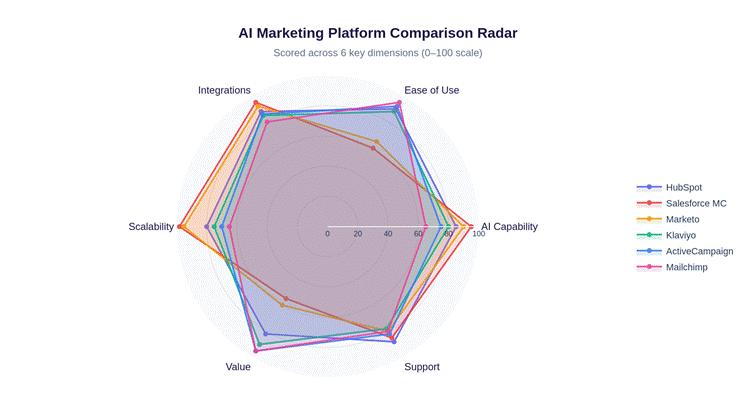
Figure 4: Platform Comparison Radar — Multi-dimensional scoring across AI capability, ease of use, integrations, scalability, value, and support
Eight AI Capabilities That Separate Real Platforms From Marketing Fluff
Vendors will tell you everything is ‘AI-powered’ in 2026. Most of that is noise. Here’s the framework I actually use to evaluate what matters — eight capabilities that distinguish platforms doing genuine ML-driven intelligence from those slapping an ‘AI’ badge on features that have existed since 2018.
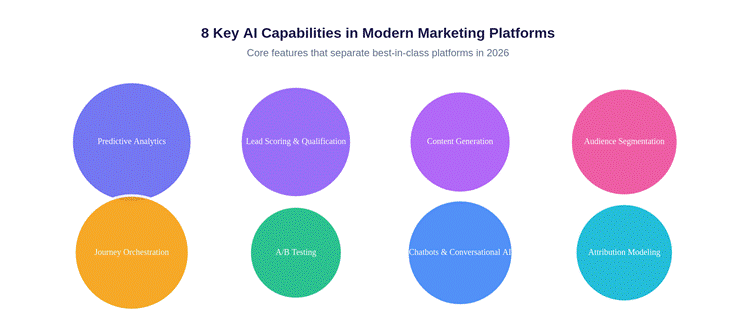
Figure 5: Eight core AI capabilities that differentiate best-in-class marketing automation platforms in 2026
1. Predictive Analytics & Behavioral Forecasting
Good platforms don’t just report what happened — they tell you what’s about to happen. Churn probability scoring, purchase propensity rankings, campaign performance forecasting — these are the capabilities that let you act before problems surface rather than autopsying campaigns after the fact. The key is continuous model improvement: every data point your platform processes should make its predictions more accurate over time.
What to demand: Pre-built predictive models for the big use cases (churn, CLV, next best action), the ability to train custom models on your specific data, real-time scoring updates, and — this one’s underrated — explainable AI that shows why a prediction was made. If the platform can’t tell you why it thinks a lead will convert, that’s a problem.
2. AI Lead Scoring That Actually Works
Traditional lead scoring is a house of cards. Someone on your team decided six months ago that ‘downloaded an ebook’ is worth 15 points and ‘visited the pricing page’ is worth 25, and now those rules are baked in and nobody touches them. Sound familiar? AI lead scoring uses ML to continuously refine the model based on which leads actually close — factoring in hundreds of behavioral and demographic signals simultaneously, updating as your market evolves.
The business impact is real: organizations using AI lead scoring consistently report 20-30% improvements in lead-to-opportunity conversion rates and meaningful reductions in sales cycle length. Your sales team stops chasing ghosts. That alone can transform a sales-marketing relationship.
3. Content Generation & Optimization — The Big One Right Now
This is where most of the interesting energy is in 2026. AI content capabilities have moved way past generating mediocre first drafts. The best platforms now learn which content variations perform best with which audience segments — creating a continuous optimization loop that manual testing simply cannot match for velocity. Your creative team doesn’t get replaced; they get to focus on the brand strategy and conceptual work instead of writing the 12th variation of a cart abandonment email.
- Email subject line generation and automated A/B testing — runs continuously without anyone scheduling a test
- Dynamic content blocks that adapt per subscriber segment — the same email looks different to different readers
- AI-suggested CTAs based on funnel stage and intent signals — contextually appropriate, not generic
- Automated copy variations for multivariate testing at a velocity no human team can match
- Brand voice consistency checking across generated content — catches off-brand outputs before they ship
4. Audience Segmentation Beyond the Obvious Cuts
Demographic filtering isn’t segmentation anymore — it’s table stakes. Real AI-driven segmentation clusters contacts based on behavioral patterns, purchase cadence, engagement signals, content preferences, and dozens of other variables — creating micro-segments that update dynamically as behavior changes. The practical outcome: the right content reaches the right audience without a human manually maintaining increasingly complex segmentation logic that’s already six weeks out of date.
5. Multi-Channel Journey Orchestration — The Real Power Play
The average customer journey in 2026 touches seven-plus channels before conversion. No team can manually optimize that. AI-powered journey orchestration determines the optimal next action for each individual — email, retargeting ad, sales call trigger, in-app notification, SMS — based on real-time behavioral signals and predictive models. This ‘next best action’ capability is what enterprise teams are genuinely willing to pay large platform fees for. When it works well, it’s remarkable.
6. Automated Testing That Never Sleeps
Why are teams still running manual A/B tests in 2026? Wait for significance, analyze, implement winner, repeat — that cycle takes weeks and only runs when someone remembers to check the results. AI-powered testing platforms run multi-armed bandit experiments continuously, automatically allocate traffic to better-performing variants in real time, and implement winning combinations without a meeting. What used to take a quarter of testing cycles now optimizes 24/7. I’ve seen platforms improve conversion rates by 15-20% over three months purely from continuous automated testing — without a single human-initiated test.
7. Conversational AI That Doesn’t Embarrass You
The chatbots of 2019 were an industry embarrassment. The conversational AI tools built into good marketing platforms in 2026 are a different animal entirely. They qualify leads through natural dialogue, schedule sales meetings, answer detailed product questions, deliver personalized content recommendations, and hand off to human agents at exactly the right moment — available around the clock, at unlimited scale, with consistent brand voice. And when the chatbot interaction feeds directly into your CRM and automation workflows, you get a complete picture of buyer behavior that didn’t exist before the conversation even started.
8. Attribution Modeling — Finally, Answers That Hold Up
First-touch attribution gives all credit to the blog post someone read nine months ago. Last-touch attribution ignores everything except the demo request. Both are wrong. AI attribution models analyze the actual contribution of every touchpoint in the customer journey — using ML to assign credit based on real conversion patterns in your specific data, not generic industry rules. The result: budget allocation decisions that reflect reality. I’ve seen teams shift 30% of their paid media spend based on AI attribution findings — and prove it was the right call in the next quarter’s results.
The 7-Step Implementation Roadmap (That Actually Works)
Here’s the thing about implementation: this is where companies separate. The technology is largely available — the gap between successful and failed AI automation programs almost always comes down to how organizations prepare, train, and execute. I’ve watched enough implementations to see the patterns clearly. Follow these seven steps. Not some of them — all of them.

Figure 6: 7-Step Implementation Roadmap — A proven path from MarTech audit to AI-native marketing operations
Step 1: Audit Your Existing MarTech Stack First
Before you add anything new, map what you have. What tools are you actually using? Where are the data silos — the customer data that lives in six different places and never talks to each other? What integrations already exist and which gaps create daily friction? Most critically: what is your current data quality situation? AI platforms are ruthless amplifiers — they make good data better and bad data catastrophically misleading. I’ve seen companies invest six figures in automation and get worse results than before, because the underlying data was a mess that the AI faithfully reflected.
Step 2: Define Objectives That Are Actually Specific
“Improve our marketing” is not an objective. ‘Reduce cost-per-lead by 25% in Q3’ is an objective. ‘Improve email open rates from 18% to 22% within 90 days’ is an objective. Pick two or three specific, measurable targets for your first implementation phase. This focus does three things: it drives implementation decisions, it enables clear ROI measurement, and it builds the internal credibility you’ll need to justify expanded investment when budget season comes around. Vague objectives produce vague results and vague results get automation programs defunded.
Step 3: Platform Selection — Go Deeper Than the Demo
Use the comparison in this guide as a starting point, but don’t stop there. Demand demos built around your specific use cases — not the vendor’s standard presentation. Ask for case studies from companies with your business model, your size, your growth stage. Test the integration compatibility with your existing CRM and analytics tools before signing anything. Ask vendors about their typical implementation timeline and where most customers get stuck. The best predictor of success isn’t feature depth — it’s whether your actual team can operate the platform without a consultant on speed-dial.
Step 4: Fix Your Data Before You Automate It
Garbage in, garbage out — everyone knows this principle and approximately nobody acts on it before go-live. Remove duplicates. Standardize field formats. Fill in critical missing data. Purge non-consent contacts. Implement proper GDPR and CCPA consent tracking frameworks. Build ongoing data hygiene processes into your lead capture workflows, not as an afterthought audit six months post-launch. I’ll say it plainly: the single most common reason AI marketing automation underperforms is poor data quality. Not the platform, not the strategy — the data.
Step 5: Actually Map the Customer Journeys
Document your ideal customer journey for each key segment. For every stage: what’s the trigger (what action starts this automation), the action (what the system does), the exit conditions (what moves someone out), and the success metric. Start with your highest-value prospect segment’s nurture journey — not everything at once. Build it. Test it thoroughly. Learn from it. Then expand. The teams that try to automate their entire funnel in month one almost always produce mediocre automations everywhere instead of excellent ones where they matter most.
Step 6: Train Your Team — Don’t Skip This Step, Seriously
Every implementation that fails, I can trace back to inadequate team training. Every single one. Marketing automation platforms require skilled operators — not just people who attended a two-hour onboarding session. Your team needs platform fundamentals, automation logic and workflow architecture, data interpretation and reporting skills, prompt engineering for AI content features (yes, this is a real and valuable skill), and compliance training. The professionals commanding $75,000–$120,000+ right now — with specialists in SF and NYC hitting $150,000+ — are the ones who built these skills systematically. Certifications from HubSpot Academy, Salesforce Trailhead, Marketo’s MCE program all provide structured paths. Budget for them.
Step 7: Launch Small, Measure Everything, Iterate Fast
One workflow. One audience segment. Watch it closely. Measure against your defined objectives. Collect team feedback on what’s clunky. Identify the first optimization opportunities. Most AI automation workflows improve substantially in the first 90 days as the platform accumulates data and refines its models — but only if someone is actually reviewing the signals and making adjustments. Weekly performance reviews in the early months, monthly once the program matures. Document what works and why. That institutional knowledge compounds.
⚡ What Actually Works as a First Automation
Start with a welcome email series for new subscribers. It’s simple, immediately valuable, easy to measure, and builds team confidence fast. Every organization that has successfully scaled sophisticated marketing automation started with something exactly this basic before touching complex journey orchestration. Don’t let perfect be the enemy of running.
The Skills That Command Top Salaries in 2026 — And How to Build Them
I track salary data obsessively because it’s the most honest signal of what the market actually values — not what conference keynotes say it values. The pattern in 2026 is crystal clear: professionals who combine traditional marketing expertise with genuine AI fluency and data literacy are commanding salaries that would have seemed aggressive two years ago.
Senior digital marketing professionals with AI skills are landing $75,000–$120,000+ annually. Specialists in San Francisco and New York are clearing $150,000+. That’s not a coincidence — it’s the market pricing a scarce combination. Here are the eight skills that make up that combination.
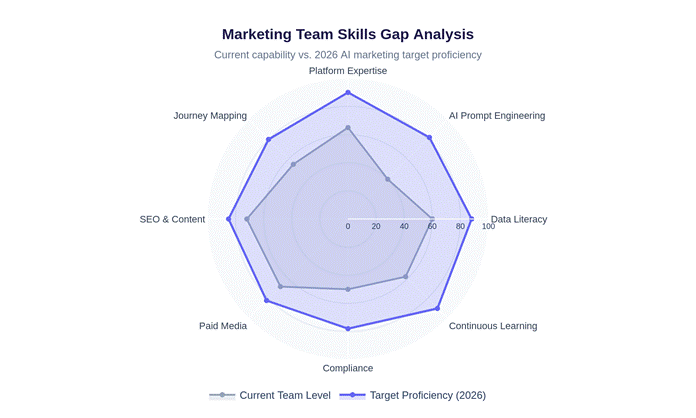
Figure 7: Marketing Team Skills Gap Analysis — Current capability vs. 2026 AI marketing target proficiency across 8 dimensions
1. Data Literacy — The Absolute Non-Negotiable
Your team has to be able to read marketing performance data, understand correlation vs. causation (more teams get this wrong than you’d expect), build attribution reports, and translate data into actual strategic decisions — not just narrative. Proficiency with Google Analytics 4, your platform’s native analytics, and at least one BI tool (Looker, Tableau, Power BI) is now expected at the specialist level. If your team treats the analytics dashboard as something they screenshot for monthly reports but don’t actually interrogate, that’s the problem to fix first.
2. AI Prompt Engineering — An Actual Skill, Not a Gimmick
Every time I hear ‘prompt engineering’ dismissed as buzzword fluff, I watch the same person spend 45 minutes editing AI-generated copy that a well-engineered prompt would have gotten right in two iterations. Writing effective prompts — providing adequate context, specifying tone and brand voice, defining audience parameters, iterating intelligently on outputs — is learnable and genuinely accelerates output quality. Invest in developing this across your team. The ROI is embarrassingly fast.
3. Deep Platform Expertise — Certifications Actually Matter Here
Using your marketing automation platform isn’t the same as understanding it. Deep expertise means: knowing the data model, building complex conditional automation logic, configuring lead scoring models that don’t decay in three months, managing integrations without breaking things, troubleshooting performance issues before they become crises, and optimizing workflows based on actual performance data rather than guesswork. HubSpot Academy, Salesforce Trailhead, Marketo Certified Expert — these certifications represent structured learning paths that validate real capability. More hiring managers are requiring them. Build a plan.
4. Customer Journey Mapping — Where Strategy Actually Lives
Here’s what the tool vendors don’t tell you: sophisticated automation running a poorly-mapped journey produces sophisticated bad results. Understanding your customer’s actual decision-making process — what information they need at each stage, what objections stall them, what triggers move them forward, what signals indicate purchase readiness — is the strategic foundation that determines whether your automation performs. This skill bridges marketing, customer success, and product in ways that make it enormously valuable. It also doesn’t show up in any platform certification, which means it’s undersupplied.
5. SEO & Content Strategy as Automation Fuel
Automation needs content to deliver. A lot of it. At every stage of the funnel. The marketers who understand how SEO-driven content strategy feeds the automation engine — how an organic blog post that ranks becomes a lead that enters a nurture workflow that converts to pipeline — are building systems with compounding returns. Content that generates organic leads into automation workflows is effectively free pipeline generation once the system is running. That’s a meaningful business advantage.
6. Paid Media Integration — Because the Channels Shouldn’t Be Siloed
The most powerful automation programs I’ve seen treat paid and owned channels as a single system, not parallel operations managed by different people who barely talk. Using CRM data to build custom audiences for remarketing campaigns, using automation behavioral signals to optimize bid strategies, creating seamless handoffs between paid acquisition and owned nurture — this cross-channel fluency is becoming a meaningful differentiator as the gap between sophisticated and basic programs widens.
7. Privacy & Compliance — Not Optional, Not Someone Else’s Job
GDPR and CCPA violations aren’t just legal risk anymore — they kill email deliverability, tank ad performance, and damage brand trust with customers who are increasingly data-sophisticated. Every person on your marketing automation team needs baseline knowledge of consent management, data retention policies, and permissible data use. The teams that treat privacy compliance as a marketing capability — not a legal obligation to outsource — actually perform better across all the metrics that matter.
8. The Learning Mindset — The One You Can’t Certify
This is the hardest one to hire for and the most important one to build. The AI marketing landscape is changing faster than any curriculum can track — what was cutting-edge at the start of this year is table stakes by the end of it. The teams maintaining competitive advantage aren’t the ones who attended the right training in 2024. They’re the ones with actual habits of continuous learning: industry publications, hands-on tool experimentation, conference attendance, peer networks. Budget for this as a line item. Make it a cultural expectation, not a personal indulgence.
Skill Development: Certifications and Resources Worth Your Time
| Skill Area | Key Certifications | Learning Resources |
| Data Analytics | Google Analytics Certification, GAIQ | Google Skillshop, Coursera, DataCamp |
| Marketing Automation | HubSpot Certification, Marketo MCE, Salesforce Marketing Cloud | HubSpot Academy, Salesforce Trailhead, Adobe Digital Learning |
| Paid Media | Google Ads, Meta Blueprint, LinkedIn Marketing Labs | Google Skillshop, Meta Blueprint, LinkedIn Learning |
| AI & Prompt Engineering | AI for Marketing (Coursera), ChatGPT Prompt Engineering | DeepLearning.AI, Prompt Engineering Guide, HubSpot AI Course |
| Email Marketing | HubSpot Email Marketing, Mailchimp Fundamentals | HubSpot Academy, Only Influencers, Email on Acid Blog |
Proving the ROI — Metrics That Actually Hold Up in Budget Meetings
John Wanamaker’s famous ‘half my advertising is wasted’ problem? That’s precisely what AI marketing automation is designed to solve. But proving the ROI to your CFO requires tracking the right metrics from day one — not retrospectively building a case after you’ve already spent the money. Here’s the framework I use, organized by measurement horizon.
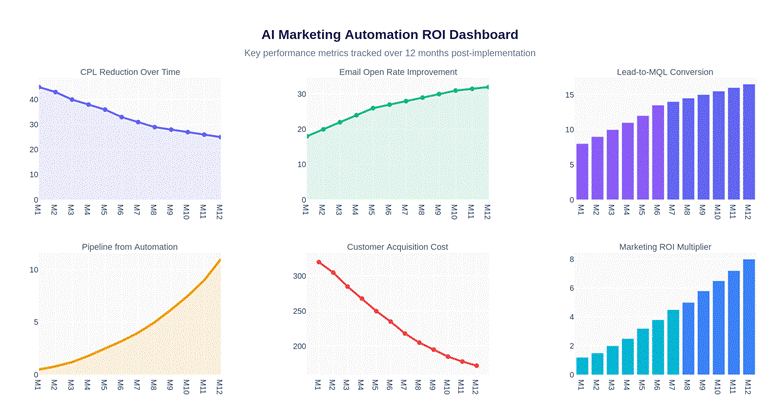
Figure 8: AI Marketing Automation ROI Dashboard — Six key performance metrics tracked over 12 months post-implementation
Tier 1: Operational Efficiency — The Quick Wins You Show First
These metrics prove automation is paying for itself in hours and costs — which you can show in the first 60-90 days, before revenue attribution data matures enough to be meaningful:
- Time saved on manual tasks: Track weekly hours previously spent on manual segmentation, campaign setup, and reporting. Multiply by average hourly cost. This number is usually shocking.
- Cost per lead (CPL): Compare CPL before and after automation implementation. Most well-run programs see 20-40% reduction within the first six months.
- Marketing operational costs: Track total tool costs, headcount costs, and agency fees relative to leads and pipeline generated — not in isolation.
- Campaign setup time: Hours from campaign concept to launch. Automation should cut this significantly — if it hasn’t, something in your workflow is broken.
Tier 2: Engagement & Conversion — The Middle of the Funnel
These metrics show whether the automation is actually moving the needle on marketing effectiveness — not just saving time:
- Email open rates and CTRs: Benchmark against pre-automation performance and category averages. AI send-time optimization consistently pulls 10-25% open rate improvements in real deployments — if you’re not seeing that, dig into why.
- Lead-to-MQL conversion rate: The percentage of leads meeting Marketing Qualified Lead criteria. AI lead scoring should visibly improve this — track it weekly in the first 90 days.
- MQL-to-SQL conversion rate: Marketing-qualified to sales-accepted. Higher MQL quality should mean higher sales acceptance — watch this metric to catch scoring model problems early.
- Funnel velocity: Average time from lead creation to close. Automation should accelerate progression — if it’s stalling, look at your nurture sequence timing and handoff triggers.
- Form completion and landing page conversion rates: Track the impact of personalized content on conversion performance; your control vs. personalized variant data is gold.
Tier 3: Revenue Impact — The Numbers That Actually Matter
This is what justifies the investment to leadership — and frankly, what you should be measuring from day one even if the data isn’t meaningful yet for the first few months:
- Pipeline generated by marketing automation: Total value of opportunities with automation touchpoints — use multi-touch attribution, not last-touch.
- Revenue attributed to marketing automation: Closed revenue from opportunities generated or influenced by automation workflows. Track both sourced and influenced separately.
- Customer Lifetime Value (CLV): Track whether automated personalization programs increase CLV over time — this is the long-game proof point.
- Customer acquisition cost (CAC): Total marketing spend divided by new customers acquired. Automation should meaningfully improve this ratio — if it’s not, your funnel conversion has a leak.
- Customer retention rate: Whether automated nurturing and loyalty programs are reducing churn. A 5% improvement in retention often outperforms a 25% improvement in acquisition rates for the math.
- Marketing ROI: (Revenue attributed to marketing minus marketing investment) divided by marketing investment. The benchmarks I work with: 5:1 is good, 10:1 is excellent. Most mature programs I’ve seen land in the 6:1–8:1 range after 18 months.
ROI Benchmarks by Implementation Maturity — What to Expect and When
| Maturity Stage | Timeline | Key Metrics Improved | Typical Impact |
| Initial Adoption | 0–3 months | Time savings, email KPIs | 15-25% time reduction; +10% open rates — enough to justify Phase 2 budget |
| Optimization | 3–9 months | CPL, lead quality, funnel velocity | 20-40% CPL reduction; +20% lead quality — this is when sales starts paying attention |
| Scaling | 9–18 months | Pipeline, revenue, CLV | 2-5x pipeline from marketing; +15% CLV — the numbers that get you a seat at the strategy table |
| AI-Native | 18+ months | Full-funnel ROI, retention | 5-10x marketing ROI; 20-30% lower churn — these are the programs that make CFOs believers |

Figure 9: ROI by Implementation Maturity Stage — How automation performance compounds from initial adoption to AI-native operations
The Five Challenges That Kill Implementations (And How to Beat Them)
Every implementation hits friction. The teams that succeed aren’t the ones that avoided problems — they’re the ones that anticipated them. Here are the five failure modes I see most consistently, and what actually works to address them.
Challenge 1: Data Quality — The Problem That Compounds
The core issue: AI automation amplifies whatever data you feed it. If your database has 40% duplicate contacts, missing fields across critical segments, and inconsistent formatting from five different lead capture sources — your AI will faithfully reflect all of that chaos at scale. I’ve watched companies spend $200,000 on a Salesforce Marketing Cloud implementation and underperform their previous basic Mailchimp setup, purely because the underlying data was a disaster.
The fix: Implement a data governance framework before you flip the switch — not as a post-launch audit. Audit and deduplicate your database. Enforce field standardization at data capture. Define required fields for key automation logic. Add automated data enrichment through Clearbit or ZoomInfo for high-value segments. Assign someone actual ownership of data quality — not as a hat they wear occasionally, but as a real accountability. Build data hygiene checks into every lead capture form.
Challenge 2: Integration Complexity — The Plumbing Nobody Wants to Talk About
The average marketing team in 2026 uses 12+ tools. Getting them to share data seamlessly — so a sales activity in your CRM updates automation behavior, and a website conversion updates your CDP — requires real integration work that vendors consistently undersell in demos. Fragmented data across siloed tools is one of the top three reasons marketing automation underperforms. I’ve seen this wreck otherwise sound implementations.
The fix: Prioritize platforms with strong native integration ecosystems — HubSpot and Salesforce lead on this. Seriously consider a Customer Data Platform or middleware layer (Zapier and Make for SMB, MuleSoft for enterprise) to unify data flows. When evaluating any new tool, integration capability is a primary selection criterion — not a footnote. Document your data architecture so that when an integration breaks at 3am on a Thursday, someone can fix it without calling you.
Challenge 3: Team Resistance — The Human Variable
Marketing veterans who’ve built expertise in manual processes feel — sometimes rightfully — that automation threatens the value of what they’ve spent years developing. Sales teams resist AI lead scoring when it contradicts their gut feel about which prospects are worth chasing. These dynamics are real, they’re human, and ignoring them is how good automation projects die slow deaths from passive non-adoption.
The fix: Name the resistance explicitly and address it before launch. The message that’s true and that actually lands: AI automation handles the tedious work so humans can focus on the creative, strategic, and relational work that AI genuinely can’t do well. Involve skeptics in the implementation — have them design automation logic, review AI content outputs, interpret reports. Celebrate wins publicly. Make the learning curve visible and normal. Change management isn’t soft — it’s mission-critical infrastructure for adoption.
Challenge 4: Privacy Compliance — Not Just a Legal Problem
GDPR and CCPA aren’t the ceiling anymore — they’re the floor. The global privacy regulatory landscape is tightening, and AI-driven marketing decisions add new dimensions of compliance complexity. The risk isn’t just fines; it’s deliverability impact, ad platform account health, and brand trust with customers who are increasingly tracking how their data gets used.
The fix: Build compliance into your automation architecture from the beginning. That means robust consent management platforms at every data capture point, data minimization practices, clear retention policies with automated purging of expired data, regular workflow compliance audits, and AI bias monitoring. The teams doing this well are treating privacy practices as a brand differentiator — and communicating their approach transparently to customers. It’s a trust signal that’s becoming meaningfully important.
Challenge 5: Over-Automation — When You Automate Away the Human Part
This is the failure mode nobody talks about because it feels like a success until the unsubscribe rates start climbing. Poorly configured automation produces the opposite of personalization: everyone gets the same generic nurture sequence, AI-generated copy sounds mechanical and off-brand, and what should feel like 1:1 engagement feels like obvious, soulless spam. I’ve seen brand perception measurably damaged by automation programs that were technically functional but catastrophically generic.
The fix: Balance is the actual answer here — not a platitude, but a structural principle. Not every customer interaction should be automated; some touchpoints should specifically trigger human outreach. Build human review into content approval workflows for AI-generated copy. Develop a detailed brand voice guide and bake it into every AI content prompt. Monitor unsubscribes, spam complaints, and negative sentiment as early-warning indicators before they become customer relationship problems. Automation should make interactions feel more relevant, not less real.
Where This Is All Heading — 2026 and the Years After
The pace of change in this space genuinely accelerated in 2024-2025. What’s live now would have been research-grade two years ago. Here’s where the honest signals point — and where I’d be investing time and organizational energy if I were building a marketing team from scratch right now.
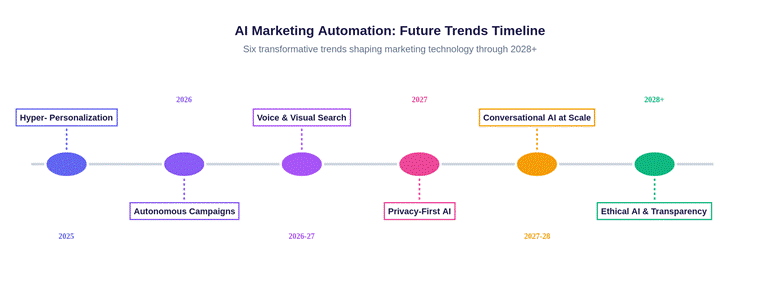
Figure 10: AI Marketing Automation Future Trends Timeline — Six transformative capabilities shaping the industry through 2028+
Trend 1: True 1:1 Personalization — Not the Current Approximation
What we have today is segment personalization dressed up as individual personalization — everyone in a cohort gets the same ‘personalized’ version. By 2027, the leading platforms will dynamically assemble entirely unique experiences for each individual: email content, website layout, ad creative, product recommendations — constructed in real time from hundreds of behavioral, contextual, and predictive signals. The teams that will win that capability race are the ones investing now in the first-party data infrastructure and AI model training that powers it.
Trend 2: Autonomous Campaign Management — AI Running Campaigns, Not Just Executing Them
The logical endpoint of what we’re building is campaigns that AI doesn’t just run — it designs and optimizes with minimal human input. We’re seeing early versions right now: platforms that automatically A/B test creative, shift audience targeting, reallocate budget between channels, and revise messaging based on performance signals. By the late 2020s, AI agents will manage entire campaign categories autonomously. Human oversight shifts from execution to strategic direction and brand governance. The marketers who will thrive are already practicing this mental model.
Trend 3: Voice and Visual Search — The Channels Most Teams Are Ignoring
Smart speaker adoption is growing. Visual search capabilities — searching with images rather than text — are being embedded in every major platform. The marketing automation tools that move first to integrate these touchpoints into journey orchestration — personalizing visual search results, tracking voice query interactions in customer profiles, triggering automated responses to voice-initiated commerce — will have a real advantage window. Voice and visual commerce aren’t fringe use cases anymore for e-commerce brands.
Trend 4: First-Party Data Strategy — This One Isn’t Optional
The third-party cookie deprecation story has been playing out in slow motion for three years, but the end state is now clearly in sight. The brands winning in the post-cookie era are the ones that built rich first-party data assets through genuine value exchange: loyalty programs, content subscriptions, assessment tools, community platforms where customers actually want to participate. AI marketing automation will increasingly be powered by first-party behavioral intelligence rather than third-party targeting — which rewards brands that earned customer data trust and punishes those that rented it.
Trend 5: Conversational AI That’s Genuinely Indistinguishable
The LLM capabilities improving conversational AI are moving faster than I can update this section. By 2027, AI chatbots and conversational marketing tools will handle complex qualification conversations, product demonstrations, objection handling, and personalized recommendations in ways that are functionally indistinguishable from a skilled human SDR in most standard scenarios. The organizations deploying sophisticated conversational AI today are building the training data and optimization advantage that will make their systems dramatically more effective than competitors who wait.
Trend 6: Ethical AI and Algorithmic Transparency — The Regulatory Wave Coming
The EU AI Act is already creating compliance requirements for AI-driven decision-making. U.S. AI regulation is fragmented but accelerating. More importantly, consumer scrutiny of algorithmic decision-making is sharpening — people are increasingly paying attention to how AI influences the experiences they receive. The progressive marketing organizations are getting ahead of this with AI governance frameworks, regular bias audits, and transparent customer communication about AI use. This isn’t compliance theater — it’s becoming a genuine brand differentiator with sophisticated consumers.
The Bottom Line — Stop Deliberating, Start Doing
Look, I’ve covered a lot of ground here. Tools, capabilities, implementation steps, ROI frameworks, failure modes, future trends. Let me give you what actually matters, stripped down.
- AI is not replacing you — it’s raising the ceiling of what skilled marketers can accomplish. The shift is from execution to orchestration, and the marketers who embrace this are more valuable, not less.
- Marketing automation isn’t a competitive advantage anymore — it’s table stakes. The 230,000+ unfilled positions and the scale of modern digital advertising have made manual marketing increasingly untenable. The question isn’t whether; it’s how well.
- Platform selection matters less than you think. The quality of your data, clarity of your strategy, skills of your team, and rigor of your measurement are more predictive of success than which vendor logo is on your contract.
- Implementation is where you succeed or fail. Follow the 7-step roadmap. Start with quick wins. Invest in team training like it’s a line item, not an afterthought. Build the measurement infrastructure from day one.
- The winners won’t be the teams with the biggest budgets. They’ll be the teams that combine human creativity and strategic judgment with AI’s analytical speed. That combination is genuinely hard to beat.
The organizations dominating their markets by the end of this decade are already building AI marketing automation as a core strategic capability — not a tech experiment, not a cost reduction initiative, but a genuine competitive edge. The U.S. digital advertising market is heading to $975 billion by 2032. That market goes to teams who combine human insight with AI precision.
Hi, this is a comment.
To get started with moderating, editing, and deleting comments, please visit the Comments screen in the dashboard.
Commenter avatars come from Gravatar.